
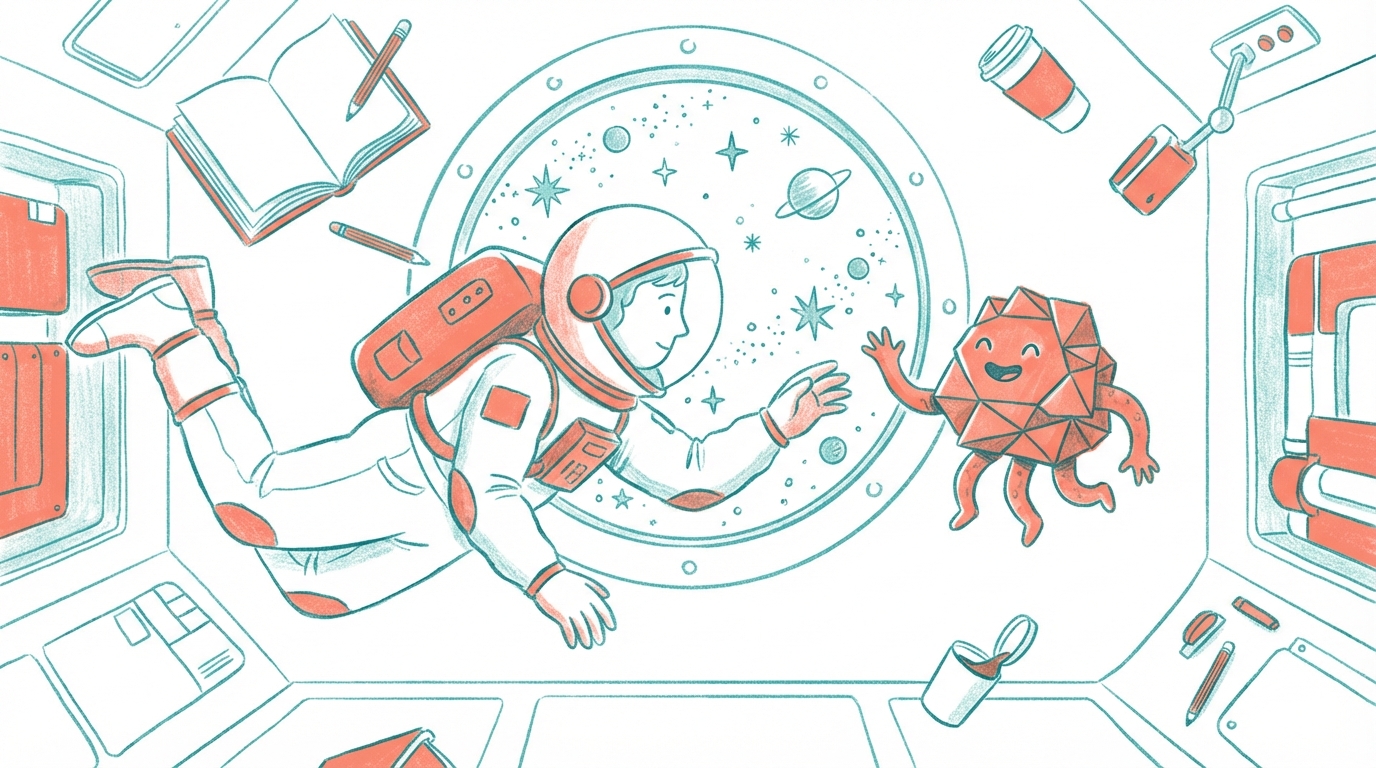
Project Hail Mary landed in theaters two weeks ago and it's already sparking a familiar chain reaction: kid sees movie, kid wants to read the book, parent wonders what they're handing over. This happens with every big sci-fi adaptation, and Andy Weir's story has a particularly strong pull on the middle-school-and-up crowd. The science is genuinely exciting. The main character is a teacher. And there's an alien.
This post is for parents making that call. Project Hail Mary (2021) is an adult novel, but it crosses over to teen readers in a way few adult sci-fi books do. Whether it's right for your kid depends less on a single content flag and more on what your family's baseline comfort is with heavy themes. Let me break it all down.
The Quick Take
| Age Rating (Common Sense Media) | 14+ (editors); parents reviewers say 12+ |
|---|---|
| Publisher's Recommended Age | 14-18 |
| Language | Moderate. About 4 uses of "f--k," mostly from supporting characters. Protagonist uses "darn" and "shoot." |
| Violence | Low. No gore. Two crew members die (off-page or briefly mentioned). Existential threat, not graphic violence. |
| Sexual Content | Minimal. Two secondary characters have a relationship mentioned in passing. No details. |
| Dark Themes | Yes. Human extinction, loneliness, sacrifice, and the ethics of sending someone on a mission they can't come home from. |
| Science Complexity | Moderate to high. Biology, physics, orbital mechanics. Weir makes it entertaining, but it's real science. |
| Movie Rating | PG-13 (thematic material and suggestive references). CSM rates the film age 12+. |
Why Parents Are Asking About This Book Right Now
Project Hail Mary has been quietly popular with STEM-minded teens since it came out in 2021. But the Ryan Gosling film changed the audience dramatically. Suddenly it's not just the kids who already loved The Martian asking for it. It's every kid who walked out of the theater last weekend saying "the book is supposed to be even better."
The teacher angle also matters here. The main character, Ryland Grace, is a middle school science teacher before he ends up on a spacecraft light-years from home. That premise has a genuine appeal to younger readers who see themselves in the classroom scenes and find the "science teacher saves the world" premise both funny and inspiring.
There's also a classroom edition of the book. Andy Weir worked with publishers to produce a version specifically for use in schools, with the handful of strong words removed. If your kid's school has assigned it, they're almost certainly using that version.
Language: The Good News
If you've read The Martian, you know Andy Weir's first book came with a reputation for profanity. He knew it too. Project Hail Mary is a deliberate course correction.
The protagonist, Ryland Grace, almost never swears. He uses "darn," "shoot," and similar substitutes throughout the book, and it's actually a character detail. He's a middle school science teacher. The few instances of stronger language come from supporting characters, mostly Eva Stratt, the formidable project director who runs the mission with an iron fist.
By the numbers, independent content reviewers count roughly 4 uses of strong language (the f-word), around 15 instances of moderate language, about 10 mild words, and approximately 30 uses of deity names as exclamations. For a 496-page adult novel, that is genuinely mild. The Common Sense Media book review specifically notes that "swearing is infrequent" and calls out the contrast with Grace's own clean vocabulary as a character choice.
This is not The Martian. Parents who filtered that one out based on language can treat this differently.
Violence and Death: Existential, Not Graphic
The stakes in Project Hail Mary don't get higher: if Grace fails, humanity goes extinct. But the way Weir tells this story is not gory or graphic. There are no battle scenes, no sustained violence, no horror-level descriptions.
Grace wakes up on the ship to find both of his crewmates dead. Their deaths are mentioned and their bodies are present, but Weir handles this with restraint. The emotional weight is there, but it's not described in graphic detail.
The bigger content consideration for younger readers is the existential scale. The book asks: what does it mean to send someone on a mission they can't come home from? What do you owe humanity if the math says your life has to be the price? These are adult themes, and Weir takes them seriously. For many teens, this kind of moral weight is exactly what makes the book compelling. For some younger readers, it may feel heavy.
The Science: A Feature, Not a Bug (for the Right Kid)
This is where Project Hail Mary earns its reputation as a gateway drug for STEM enthusiasm. Andy Weir is a self-described science nerd who obsessively researches everything he writes. The biology, physics, and orbital mechanics in the book are accurate enough that the National Science Teaching Association (NSTA) published a guide for using it in high school science classrooms.
Weir solves real problems in real time alongside his protagonist. When Grace needs to figure out how to communicate with Rocky, they work it out together using math and music. When he needs to understand how astrophage (the alien microbes threatening the sun) work, the explanation draws on actual cell biology.
For a kid who loves science or just likes watching a smart person think through hard problems, this is the best kind of reading. For a kid who wants plot and character and doesn't care about the science, it can drag. About a third of the book is essentially applied science problem-solving. That's either the whole appeal or a reason to try the movie first.
Rocky: The Reason Your Kid Will Not Put This Book Down
Here's what every parent of a kid who has read Project Hail Mary eventually learns: the alien is the reason.
Rocky is a spider-like creature from a different star system whose own planet is facing the same extinction-level threat. He communicates through musical tones. He "sees" through pressure waves. He thinks in terms of structure and engineering. And he becomes Grace's closest friend in a story that is, at its heart, about two very different beings choosing to trust each other.
The Grace/Rocky friendship is the emotional engine of the book. It's funny. It's touching. At times it is genuinely moving in a way that sneaks up on you. Readers who resist crying at books frequently report crying at this one, specifically because of Rocky.
This is worth mentioning to parents because it's not what the premise suggests. "Scientist alone in space trying to save humanity" sounds like a tense techno-thriller. What it actually delivers is one of the warmest, most unexpected friendships in recent science fiction. That's the part that hooks younger readers, and it's the part that travels well across age groups.
Dark Themes: What to Know Going In
Project Hail Mary takes several big ideas seriously, and parents should know what they are:
Loneliness and isolation. Grace spends the book entirely alone in space, billions of miles from anyone who knows him. He has no way to contact Earth, no backup, no rescue mission coming. Weir treats this existential isolation with honesty. It's not played for horror, but it's not minimized either.
Sacrifice and the ethics of the mission. Grace was selected for this mission partly without his full consent. The program that sent him up made certain decisions on his behalf, decisions reasonable people could call coercive. The book raises this explicitly and doesn't resolve it cleanly. For older teens, this is exactly the kind of moral complexity that makes a book worth discussing. For younger readers, it may be the part that sits heavy.
Human extinction. The background stakes of the book are the end of all life on Earth. Weir never lets you forget this. Some younger readers find this kind of civilizational-scale threat more distressing than standard adventure-novel danger.
None of this is gratuitous. Weir is telling a story about hope and human ingenuity, and those themes carry the book. But it's also genuinely a book about what people do when the worst possible outcome is the most likely one.
Sexual Content: Not a Concern
This one is quick. Two secondary characters are mentioned as having a sexual relationship. It's a brief, passing reference with no detail. Aside from that, there is essentially no sexual content in the book. No nudity, no romance subplot, nothing to flag.
Book vs. Movie: What Changed?
The film, directed by Phil Lord and Christopher Miller and starring Ryan Gosling, is a faithful adaptation. Fans of the book have been largely positive about it. That said, a few things shifted in translation:
The science is streamlined. The film simplifies some of the technical problem-solving that makes up a significant portion of the book. If your kid loved the movie's science sequences, the book has considerably more of that. If they found those parts slow, the book goes deeper.
Rocky gets a voice. In the book, Grace reads Rocky's translated speech on a screen and eventually learns to understand his musical language directly. The film adds a voice (provided by James Ortiz) through Grace's translation program. It works well and is one of the funnier elements of the movie.
The crew gets less development. Grace's two crewmates, who die before he wakes up, have more scenes in the book showing their relationships with him. The film trims these significantly.
Some Earth subplots are cut. The film removes several scenes of what happened on Earth during the project's development, including more about Eva Stratt's methods for keeping the mission alive. These sequences gave Stratt more moral complexity in the book.
The movie is rated PG-13 for thematic material and some suggestive references. Common Sense Media rates it age 12+. The book's already-mild language was cleaned up further for the film. If your kid saw the movie and handled it fine, the book is a safe step up in science and emotional depth but not a significant step up in content intensity.
Project Hail Mary vs. The Martian
A lot of parents are coming to Project Hail Mary through The Martian, either because their kid loved it or because they read it themselves. Here's the honest comparison:
Project Hail Mary is cleaner. The language is substantially tamer. The humor is still very much present but relies less on crude jokes. The survival problem-solving is similar in spirit but the science is more biology-heavy versus The Martian's engineering focus.
Project Hail Mary is more emotionally heavy. The Martian is fundamentally an optimistic book about a guy who refuses to give up and has a lot of fun doing it. Project Hail Mary carries more weight. The isolation feels more complete. The stakes feel more final. The friendship with Rocky brings warmth, but the book also asks harder questions about sacrifice and what we owe each other.
If your kid has read The Martian and loved it, Project Hail Mary is a natural next read and is accessible at a similar or slightly younger age than The Martian because of the language difference.
What Shelf Checkout Does
This is exactly the kind of question Shelf Checkout was built to answer. Instead of a generic age rating, you get a real content breakdown: what kind of language, how much, in whose mouth. What themes come up and how they're handled. Whether the violence is graphic or implied. What the emotional weight of the book actually feels like.
We built Shelf Checkout because "age 14+" doesn't tell you whether a specific 12-year-old in your house is ready for a specific book. Your kid is not an age range. They're a person, with their own sensitivities and their own capacity for hard ideas. We give you the content details so you can make the actual call.
If you want to check a book before your kid reads it, that's what we're here for. Early access is open now.
And for what it's worth: Project Hail Mary is a genuinely wonderful book. The Rocky friendship alone is worth the read. If your teen is ready for it, you might find yourself reading it too.