
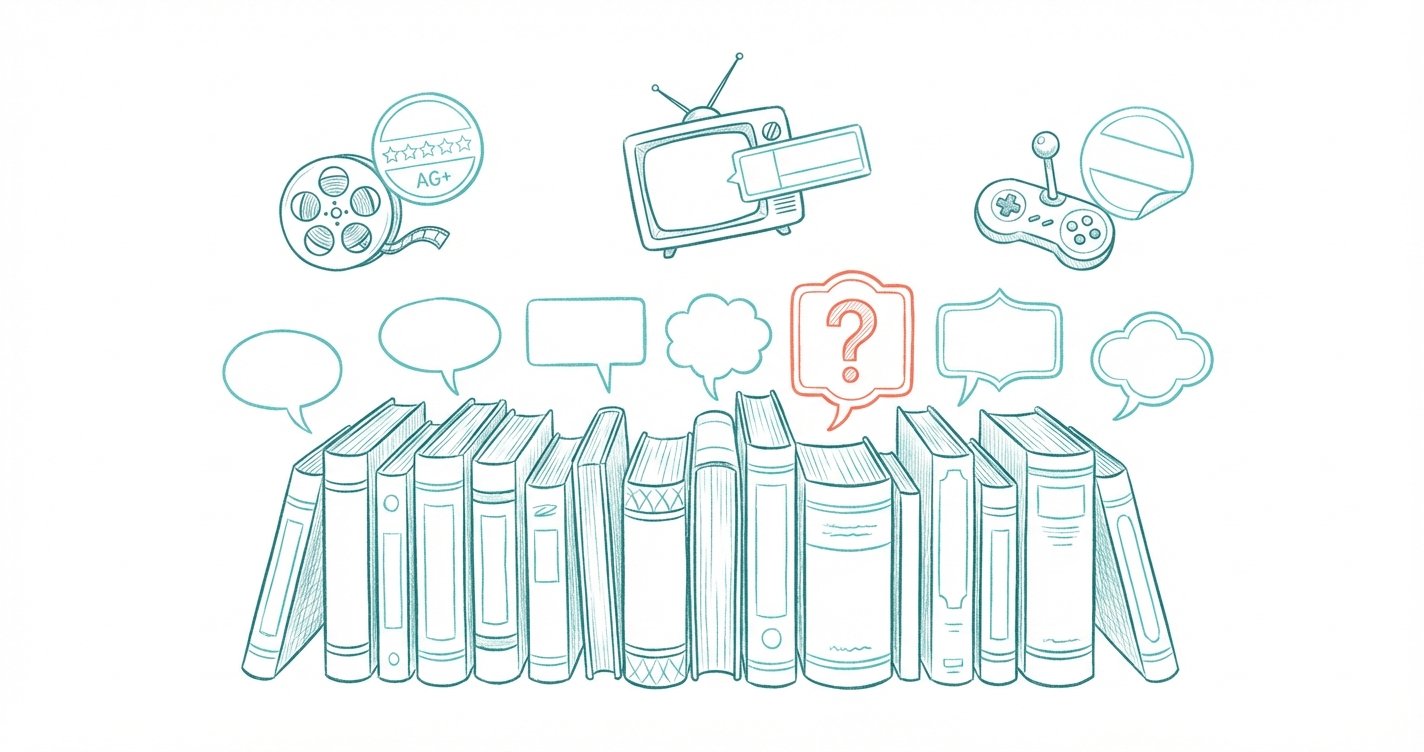
If you've ever Googled "is this book appropriate for my 10-year-old," you already know the answer to the title question. No, books don't have age ratings. Not standardized ones, anyway. And unlike most things that seem like oversights, this one is actually by design.
Understanding why helps explain the situation parents are in, and what you can actually do about it.
How Every Other Medium Got Content Ratings
To understand why books are the exception, it helps to know how movies, TV, and games got their rating systems in the first place.
Movies: The MPAA rating system (G, PG, PG-13, R, NC-17) was created in 1968. It didn't come from a place of civic virtue. The film industry created it to avoid government censorship. After decades of the Hays Code (a set of restrictive moral guidelines enforced from the 1930s), the industry realized that voluntary self-regulation was better than having the government do it for them. The MPAA was the compromise.
Video games: Same story, different decade. After Congressional hearings in 1993 about violence in games like Mortal Kombat and Night Trap, the gaming industry created the ESRB (Entertainment Software Rating Board) in 1994. Self-regulate or be regulated. They chose door number one.
Television: The TV Parental Guidelines arrived in 1997, prompted by the Telecommunications Act of 1996 and the V-chip mandate. Again: industry self-regulation as an alternative to government intervention.
See the pattern? Every content rating system in American media exists because the government threatened to step in if the industry didn't handle it themselves. Content ratings aren't a public service. They're a defensive move.
Why Books Never Got the Same Treatment
Books have been around for centuries longer than film, TV, or video games. By the time content rating became a cultural expectation for media, the publishing industry was deeply established with strong First Amendment protections. There was never a "Mortal Kombat moment" for books, no Congressional hearing, no threat of government regulation that would have pushed publishers to self-regulate.
Beyond the historical timing, several forces actively resist book ratings:
Publishers View Ratings as Censorship
The publishing industry considers content ratings a form of labeling, which they equate with censorship. Their position: once you slap a rating on a book, you've implicitly told certain readers not to read it. Authors and publishers argue this has a chilling effect on creative expression.
This isn't an unreasonable concern. The comics industry learned this firsthand with the Comics Code Authority, a self-censorship body created in 1954 that effectively dictated what comic creators could and couldn't include in their work for decades. The publishing industry watched that play out and wanted no part of it.
Libraries Oppose Labeling on Principle
The American Library Association has a formal position against labeling and rating systems for library materials. Their reasoning: labels prejudice people against reading something before they've encountered it, and intellectual freedom means every reader should decide for themselves. The ALA sees content labels as antithetical to the core mission of libraries.
Books Are Harder to Rate Than Visual Media
A movie scene of violence is explicit and obvious. Everyone watching sees the same thing. But a passage describing violence in a book lands differently depending on the reader's imagination, reading level, and maturity. The same paragraph might be deeply disturbing to one 12-year-old and completely abstract to another.
This subjectivity makes standardized ratings genuinely harder for books than for visual media. It's not impossible, but it's a real challenge.
No Industry Body to Enforce It
Movies have the MPAA. Games have the ESRB. TV has the FCC backing its guidelines. Books have... thousands of independent publishers, self-publishing platforms, and no central body that could implement or enforce a rating system even if everyone agreed to one.
What Books DO Have (and Why It's Not Enough)
Books aren't completely uncharted territory. There are some navigation tools, but they're blunter than you'd expect.
Age Range Categories
Publishers use broad marketing categories: Board Books (0-3), Picture Books (3-7), Early Readers (5-8), Middle Grade (8-12), and Young Adult (12-18). These tell you the intended audience, not the content.
This is the crucial distinction. A "Middle Grade" designation means the publisher thinks 8-to-12-year-olds are the target market. It does not mean every 8-year-old is ready for the content. And the YA category is so broad that it includes everything from gentle coming-of-age stories to books with graphic violence, explicit sexual content, and heavy drug use. "Young Adult" tells you basically nothing about what's inside.
Lexile Scores and Reading Levels
Lexile measures, Guided Reading levels, Accelerated Reader levels: these all measure reading difficulty, not content appropriateness. A book can have a 5th-grade reading level and deal with topics most parents wouldn't choose for a 5th grader.
This actually creates a particularly tricky problem. A precocious 9-year-old reader who tests at a 7th-grade Lexile level might be steered toward books that are age-appropriate for 12-year-olds in terms of content. The reading ability is there. The emotional readiness might not be.
Publisher Blurbs and Awards
Back-cover summaries are marketing copy designed to sell the book. They're not going to mention that chapter 14 gets dark. Award stickers (Newbery, Caldecott, Coretta Scott King) signal literary quality, not content appropriateness. A Newbery-winning book can absolutely contain content that gives parents pause.
Third-Party Review Sites
Organizations like Common Sense Media, Plugged In, and Compass Book Ratings fill this gap for the books they've reviewed. Common Sense Media has reviewed around 42,000 titles, which is impressive but still a small fraction of what's available. If the specific book your kid is holding hasn't been reviewed, you're back to square one.
The "Series Escalation" Problem
One of the most common ways the lack of ratings catches parents off guard is what you might call content escalation within a series.
Book one of a popular series is appropriate for your 9-year-old. Light adventure, friendship themes, age-appropriate conflict. Your kid loves it and devours three more books in the span of a month.
By book five or six, the characters are older, the stakes are higher, and the content has shifted. The violence is more graphic. There might be romantic subplots that weren't there before. The themes get heavier: depression, betrayal, death, moral gray areas that a 9-year-old's brain isn't wired to process yet.
The series started at "fine for 9" and ended up at "probably better for 13," and nobody warned you. Your kid is emotionally invested in these characters and desperate to finish the series. Telling them to stop at book four makes you the villain. Letting them continue means they're reading content you didn't sign up for.
With movies, this is a non-issue. Each film in a franchise gets its own rating. The first Harry Potter movie is PG. The later ones are PG-13. Parents can make a decision at each installment. Books offer no equivalent checkpoint.
The Manga Exception
Here's an interesting wrinkle: manga (Japanese comics) DO have content ratings. Publishers like Viz Media use ratings (All Ages, Teen, Teen Plus, Mature) on the back cover of every volume. These function almost exactly like the ESRB ratings on video games: a quick, at-a-glance content indicator that helps buyers make informed choices.
And nobody considers manga ratings to be censorship. Parents use them. Librarians reference them. Bookstores organize around them. The creative freedom of manga artists hasn't suffered.
This raises an obvious question: if manga publishers can do it without the sky falling, why can't traditional book publishers? The answer isn't that it's impossible. It's that the industry has never been forced to, and inertia is powerful.
What Can Parents Actually Do?
The rating system isn't coming. Not from publishers, not from a government body, not from an industry council. That ship has sailed. So what's the practical path forward?
1. Use Existing Review Resources
Start with Common Sense Media for popular titles. Check Plugged In for a faith-based perspective. Look at Compass Book Ratings for a standardized scale. These are genuinely valuable when the book you need has been reviewed.
2. Ask Librarians
Children's librarians are professionals who know their collections intimately. They can't officially "rate" books, but they can give you honest guidance about content. "My daughter is 10 and sensitive to scary scenes. Is this one intense?" will usually get you a helpful answer.
3. Look Up Series Before Committing
Before your kid starts a long series, spend five minutes researching the later books. Parent forums and Reddit are good for this. You'll often find "heads up, book 4 gets much darker" type comments that can save you a difficult conversation later.
4. Read Together
For books you're unsure about, consider reading them alongside your child or at least reading ahead. Not practical for every book, but for the ones that matter, it turns potentially surprising content into conversation starters.
5. Use Technology to Bridge the Gap
This is where tools like Shelf Checkout come in. AI can analyze a book in seconds against 25 content categories, give you per-child verdicts based on your family's specific values, and flag series content escalation before it surprises you. It's not a replacement for human reviews, but it covers the millions of books that human reviewers haven't gotten to.
The Real Goal: Information, Not Restriction
This conversation isn't about keeping kids from reading. It's about giving parents the information to say "yes" with confidence.
Most parents don't want to ban books. They want to know what's in them so they can decide when and how to introduce challenging content. A book about grief might be exactly what a 12-year-old needs if they've recently lost a grandparent, and exactly wrong for a 10-year-old who would be scared by it. Context matters. Timing matters. And parents can't make those calls without information.
The publishing industry isn't going to solve this. They've made their position clear. But that doesn't mean parents are stuck. Between review sites (though some have shut down), community knowledge, smart librarians, and new AI-powered tools, the information gap is closing.
Your kids deserve great books. You deserve to know what's in them.
Related: Why Your 12-Year-Old's Book Stack Needs a Second Look · How Shelf Checkout Compares to Review Sites · Frequently Asked Questions · Book Reviews for Kids: A Better Approach · Is This Book Appropriate? Here's How to Check