
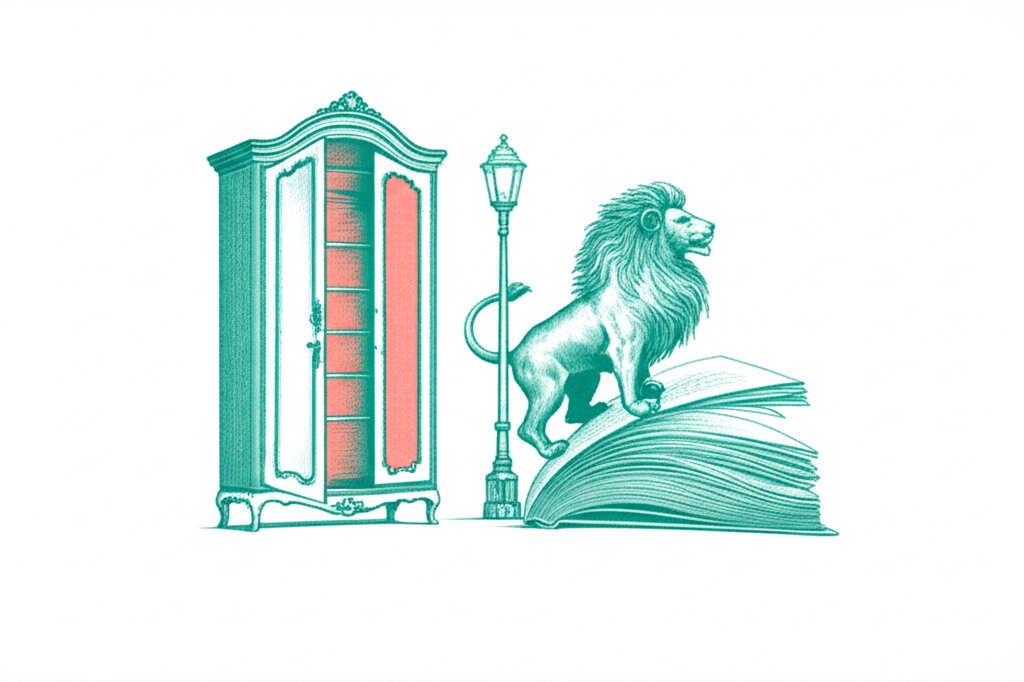
The Chronicles of Narnia have been in print since 1950. Most parents who grew up reading them carry warm memories of Aslan, the White Witch, and stepping through a wardrobe into another world. Now Greta Gerwig is bringing Narnia back to the big screen, and a new generation is about to discover it.
Before you hand these books to your kids, it's worth knowing what's inside each one. The series is mostly gentle fantasy, but it is not without darkness. The tone shifts across the seven books, some contain imagery and themes that warrant a heads-up, and The Last Battle in particular is a very different kind of book than The Lion, the Witch and the Wardrobe. This guide covers all seven in publication order.
A Note on Order
Lewis originally wrote and published these books in what is now called publication order: The Lion, the Witch and the Wardrobe first, The Magician's Nephew later. Some modern editions print them in internal chronological order (starting with The Magician's Nephew), but most readers and Lewis's own publisher recommend publication order for first-time readers. The Lion, the Witch and the Wardrobe was designed as the entry point. This guide follows publication order.
The Quick Overview
The Lion, the Witch and the Wardrobe (Book 1, published 1950)
Four siblings evacuated from London during World War II discover a wardrobe that leads to Narnia, a land under the spell of the White Witch, where it is always winter and never Christmas. Edmund is tempted by enchanted Turkish Delight and betrays his siblings. Aslan, a great lion, surrenders himself to save Edmund's life and is killed, then rises again.
Violence: Aslan is shaved, humiliated, and killed on a stone table by the White Witch and her army. The scene is written with real emotional weight. A battle sequence follows, described with some energy but no gore. Characters are turned to stone by the Witch.
Death: Aslan's death is the central emotional event of the book. He is killed, then resurrected. Father Christmas's arrival signals the Witch's power weakening. Several named animals are killed in battle.
Religious allegory: The parallels to the Christian crucifixion and resurrection are intentional and explicit. Lewis described Aslan's sacrifice as what Christ's sacrifice might look like in a different world. Parents who do not want overtly religious content should know this is woven into the plot, not incidental to it.
Scary elements: The White Witch is genuinely menacing. The army of dark creatures she commands includes werewolves, hags, and ogres. The stone courtyard of the Witch's castle, filled with petrified creatures, is described as eerie.
Themes: Betrayal and forgiveness. Sacrifice. Courage. The difference between real courage and the absence of fear. Temptation and its consequences.
Language and romance: Clean. No romance. The children are young.
Prince Caspian (Book 2, published 1951)
The Pevensie children return to Narnia to find that 1,300 years have passed in Narnian time. The Telmarines have conquered Narnia and driven the talking animals into hiding. Prince Caspian, the rightful heir, is fighting to restore Narnia. The children join his cause.
Violence: Battle scenes. Single combat. A bear that has gone wild is killed. More directly militaristic in tone than the first book, as this is explicitly a war of liberation.
Death: Several deaths in battle, including characters who are part of the action. Not graphically described.
Themes: Questioning authority. Believing in what you can't see. The cost of faithlessness. Growing up and what is lost with it (the older Pevensies are told they cannot return to Narnia).
Scary elements: The forest spirits (Bacchus and Maenads) called up by Aslan are described as wild, riotous, and frightening to the rational mind. Lewis leans into their danger alongside their joy.
Language and romance: Clean. No romance.
The Voyage of the Dawn Treader (Book 3, published 1952)
Lucy and Edmund, along with their irritating cousin Eustace, are pulled into a painting of a ship and arrive in Narnia. They sail east with King Caspian toward the end of the world, stopping at various islands and encountering magical adventures along the way.
Violence: Sea battles, a sea serpent attack, slave traders on one of the islands. Eustace is transformed into a dragon and must be "undragoned" by Aslan in a scene that involves painful skin-stripping.
Slavery: The crew discovers and rescues enslaved people on the Lone Islands, a society governed by a governor who profits from the slave trade. The content is not graphic but the concept is named directly.
Death: No major character deaths. One minor character dies heroically.
Themes: Greed and transformation. Courage in the face of the unknown. The nature of longing and the "beyond." Eustace's arc is one of the series' best character transformations.
Scary elements: The Island Where Dreams Come True is one of the most unsettling passages in the series. The sailors realize they have not arrived at a place where hopes come true, but where every dream, including nightmares, becomes real. They flee in terror. This island disturbs more readers than the sea serpent does.
Language and romance: Clean. No romance.
The Silver Chair (Book 4, published 1953)
Eustace and his schoolmate Jill Pole are called to Narnia on a quest to find the missing Prince Rilian, son of an aging King Caspian. Their journey takes them underground into the realm of the Lady of the Green Kirtle, a witch who has kept Rilian enchanted for years.
Violence: A major character is killed early in the book. Underground battle scenes. The Lady of the Green Kirtle is killed in a confrontation that involves a snake transformation.
Death: King Caspian dies of old age near the end of the book, and then briefly appears alive again in a dreamlike sequence. A character who has been a presence throughout the series dies here.
Scary elements: The Underworld is genuinely unsettling. The Lady of the Green Kirtle is one of the series' most effectively frightening villains, both beautiful and predatory. Her enchantment of Rilian, keeping him bound to a chair one hour each night to maintain his madness, is disturbing in a psychological way the earlier books are not. There is a scene where the travelers, lost underground, are invited to eat roasted meat by the Earthmen, and a reader might briefly wonder if it is human flesh. The answer is no, but Lewis clearly planted the dread.
Themes: Following signs even when you can't understand them. Obedience and trust. Being lost in the dark. The bleakness of the Underworld is the most existentially heavy imagery in the series outside of The Last Battle.
Language and romance: Clean. No romance.
The Horse and His Boy (Book 5, published 1954)
Set during the reign of Peter, Susan, Edmund, and Lucy as monarchs of Narnia, this is a standalone adventure following Shasta, a boy raised as a slave in Calormen, and Aravis, a Calormene noblewoman fleeing a forced marriage. They travel north toward Narnia with two talking horses.
Violence: Battle sequences, including descriptions of wounds and injuries that are more detailed than in the earlier books. Characters bleed. Lions attack and wound characters deliberately.
Forced marriage: Aravis's central motivation is escaping a marriage arranged without her consent to an older, cruel man. The threat is taken seriously in the narrative.
Race and representation: This is the book most frequently flagged by modern readers for racial content. The Calormenes, the main antagonists, are described with physical features and cultural practices modeled on a generalized Middle Eastern or South Asian culture, and are consistently portrayed as cruel, deceptive, and inferior to the fair-skinned Narnians. Lewis's descriptions include comparisons of dark skin to his own and to the light skin of Narnians in ways that many readers find stereotypical and offensive. This framing is not a minor subtext; it structures the entire book. The Last Battle continues this pattern. Parents who want to address this content should be aware of it before the child reads.
LGBTQ+ themes: None.
Themes: Freedom and identity. Finding your true home. Courage and endurance. The revelation of providence guiding events the characters couldn't see.
The Magician's Nephew (Book 6, published 1955)
The origin story of Narnia, following Digory Kirke (the Professor from LWW as a boy) and his neighbor Polly. Digory's Uncle Andrew, an amateur magician, tricks them into traveling between worlds using magical rings. They inadvertently wake the evil Queen Jadis in a dead world and bring her back, ultimately arriving in Narnia at the moment of its creation.
Violence: Uncle Andrew is an adult who manipulates, deceives, and physically intimidates children. His mistreatment of Polly early in the book is one of the more realistic depictions of adult cruelty toward children in the series. Jadis's destruction of her entire world (killing all its inhabitants) is established backstory, not depicted on the page, but its casual mention is jarring.
Death: Digory's mother is dying throughout the book, and his driving motivation is finding something that might save her. This thread gives the book an emotional weight that younger children may find distressing depending on their own family's experiences with illness.
Creation and religious allegory: Aslan sings Narnia into existence in one of Lewis's most vivid sequences. The religious parallels to Genesis are explicit, including the planting of a forbidden tree and a temptation scene that mirrors the Garden of Eden.
Themes: The consequences of curiosity misused. Temptation and doing the right thing at personal cost. Love for a dying parent. The creation of something new and good.
Language and romance: Clean. No romance.
The Last Battle (Book 7, published 1956)
Narnia is ending. A false Aslan, created by a scheming ape named Shift and a foolish donkey named Puzzle, is manipulating animals and humans into servitude. The true Narnia falls. Aslan calls all things to judgment. Most of the characters readers have known across the series arrive in an afterlife described as the "real" Narnia.
Violence: Battle and death are present throughout. Characters fight and die. The overall tone is one of things falling apart, of defeat before a final hope.
Death: This is where the death toll lands. Nearly all the main characters from across the series are killed off-page: they die in a railway accident and arrive in the afterlife without ceremony. King Tirian and others die in battle. The ending reframes all these deaths as a beginning, but the deaths are real within the narrative. This is a book where most of the characters you have spent seven books with do not survive.
Susan's exclusion: Susan Pevensie, who has appeared in multiple books, is not present in the afterlife. The surviving characters mention that she no longer believes in Narnia and has become preoccupied with "nylons and lipstick." She is the only one of the original four Pevensies not included. Lewis's handling of Susan has been debated extensively. Some read it as a commentary on growing up and abandoning faith; others read it as a punitive treatment of a female character who chose adult concerns over the world she came from. The text is brief and the framing is not flattering to Susan. It is worth knowing about before reading.
Race and representation: The Calormene content is more prominent here than in any other book. Calormenes serve Tash, a demon-god described with features that code as Hindu or Middle Eastern, and are largely portrayed as enemies of Narnia. One Calormene, Emeth, is depicted sympathetically and is admitted to Aslan's country because his sincere worship of Tash is deemed, by Aslan, equivalent to worshiping Aslan unknowingly. This passage has been interpreted both as universal grace and as condescending toward non-Christian faiths.
Religious allegory: The Last Battle is explicitly apocalyptic, drawing on the Book of Revelation. The ending is a depiction of heaven (described as more real and more beautiful than the world the characters knew). Parents who are not familiar with the series' religious dimensions may be surprised by how direct this book is.
Themes: The end of things and the beginning of what comes after. Faithfulness in the face of defeat. What it means that death is not the end. Susan's path is the only one that does not lead to the afterlife depicted, which raises questions the text does not fully answer.
The Series As a Whole: What to Know
The Chronicles of Narnia were written for children and most of them read that way. The first three books especially are accessible, imaginative, and emotionally manageable for younger readers. The series builds in complexity and darkness toward The Last Battle, which is a substantially different reading experience from The Lion, the Witch and the Wardrobe.
The religious allegory is not incidental to the series. It is the architecture of it. Lewis designed Narnia as an imaginative exploration of his Christian faith, and that intent shows in every book. Parents who want to discuss the allegory alongside the story will find no shortage of material. Parents who find the allegory uncomfortable should know it is present throughout.
The racial content in The Horse and His Boy and The Last Battle is the other major consideration the series has accumulated over decades of readership. Lewis was a man of his time and cultural context, and his portrayal of the Calormene people reflects biases that are now widely recognized and critiqued. Many readers still love these books; many also discuss the Calormene content critically with their children.
The series does not contain sexual content or strong language. The main content categories are fantasy violence, religious allegory, death (escalating toward the later books), and racial stereotyping in books 5 and 7.
What Shelf Checkout Does That This Guide Can't
This guide covers the most-searched titles. But your child's reading life extends far beyond the books that happen to have a Netflix adaptation coming out.
Shelf Checkout analyzes any book by ISBN and gives you a content breakdown personalized to your family's specific values. Not just what's in a book, but how it maps against the things you actually care about, with 25 content flags you configure yourself.
Related: Harry Potter Parents Guide · Wings of Fire Parents Guide · Percy Jackson Parents Guide · Hunger Games Parents Guide

